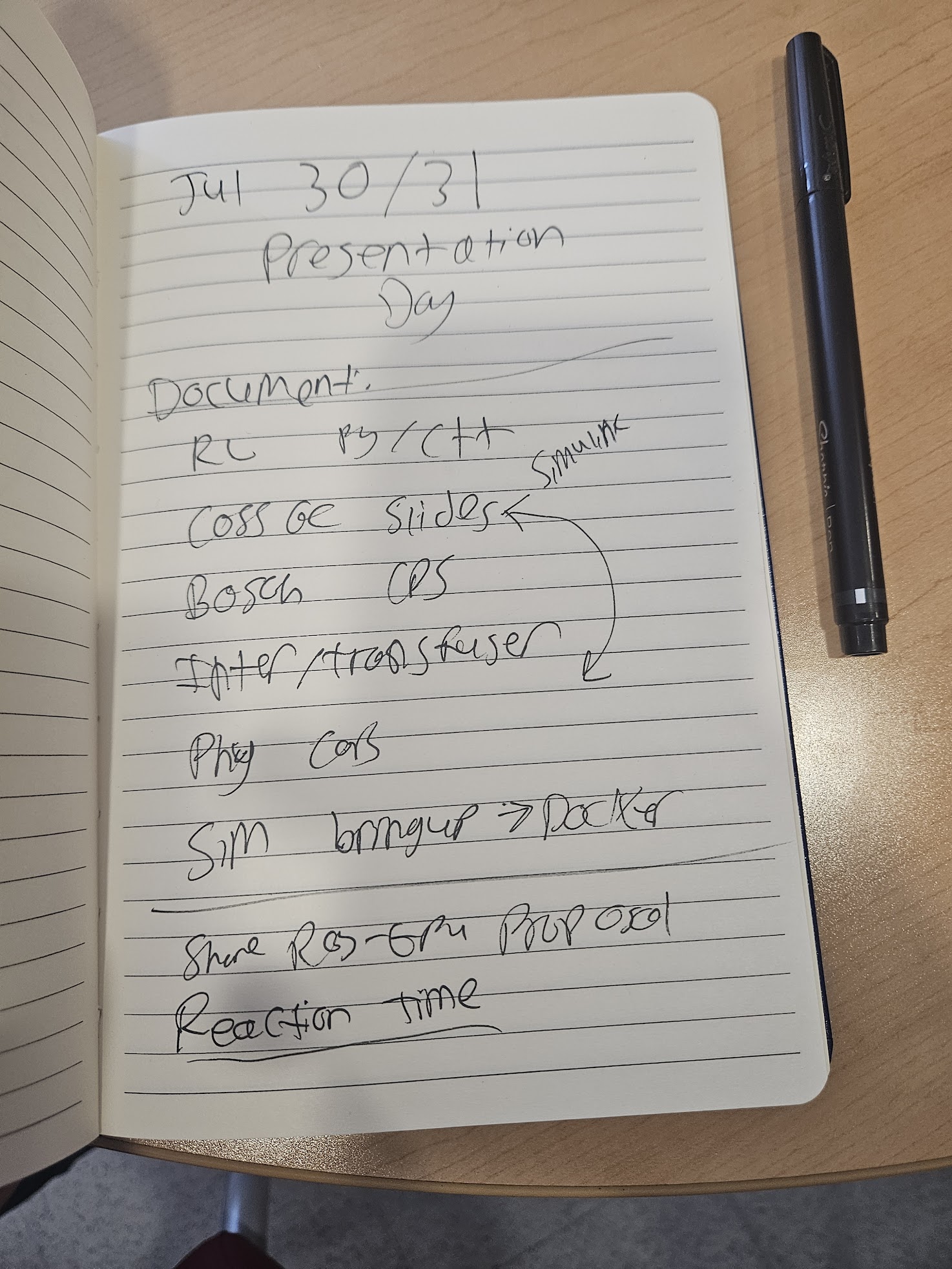
-
Reinforcement learning (Python):
- built upon F1Tenth’s f110_gym
- updated to Gymnasium (new version of openai’s now-abandonded gym)
- added parallelism, reward shaping, etc
-
- https://github.com/RTIS-Lab/f110_gym_cpp
- Kurt’s C++ re-write of the python f110_gym
- uses
libtorchinstead of pytorch - has it’s own implementation of SAC (soft-actor-critic), replay buffer, etc
- potential disadvantage: if you want to use other algos like PPO, etc - you have to implement that yourself. Thankfully, frontier AI models are decent w/ libtorch with some guidance
- includes features
- domain randomization (friction, mass, etc)
- parallel environments
- tensorboard plotting
- WIP interpretability with planned waypoints
- libSFML -based visualization - easy to add new visualizations
-
- uses a two-container setup
- sim - based off of f110_gym - provides sensor/action APIs
- drive - your algorithm code
- uses a two-container setup
-
- like our sim setup, two containers
- system - hardware drivers
- drive - algorithm code. Mostly compatible with the sim
- like our sim setup, two containers
-
Bosch Cloud Scheduling CPS Challenge
- NEW - just presented early May 2026
- they provide physics, control etc. We control timings
- FMU model can be used with Python, C/C++, Simulink etc
- FMU libraries exists for most languages
Reaction time & ROS2 mode switching
- reaction_time.pdf
- see fig. 4 and it’s discussion
COSACC
- interfuser

- this was the image I couldn’t find earlier, btw
- use transformer model to get nearby obstacles from car cameras, and a classic controller to navigate with that
- Xuntao has an implementation working
- we have a simplified version of the safety controller modeled in UPPAAL (a modeling & verification tool)
- Other side things
- obstacle/opponent detection
- in hardware - we have lidar, cameras, and intel realsense 3d cameras
- can we do this physically, or do we need to upgrade our simulators?
- or use off-the-shelf simulations?
- CUDA support for driving
- algos like localization, planning, etc. can be parallelized?
- obstacle/opponent detection